FOIs Reveal a Continuing Decline in Play Park Facilities in the UK

In the UK, one in eight children live in households with no gardens. As a result, many families rely on safe public play areas for outdoor exercise and activities within their local communities. Recent research has also shown that outdoor play has huge benefits for children’s physical health, mental health and emotional well-being. However, new […]
In the UK, one in eight children live in households with no gardens. As a result, many families rely on safe public play areas for outdoor exercise and activities within their local communities. Recent research has also shown that outdoor play has huge benefits for children’s physical health, mental health and emotional well-being. However, new FOI requests, conducted by Aggregate Industries, the UK’s leading manufacturer and supplier of sustainable construction and building materials, who also are actively involved in the support and build of playgrounds across the country, show that almost 800 playgrounds have closed over the last ten years. This new data shows a total of 793 playgrounds have been closed in the UK over the last ten years. It also revealed that there have been 28,734 reports of vandalism and 2,786 injuries in play parks across the UK over the last five years. The latest data comes after a separate series of freedom of information requests revealed local authorities shut 214 playgrounds in financial years 2014-16, blaming ‘unprecedented budget constraints’. Reflecting on the recent insights, Kirstin McCarthy, Director of Sustainability of Aggregate Industries, said: “We know that playgrounds and access to them are an essential provision for young families – not only for physical wellbeing but also mental and emotional wellbeing too. “We understand budgets are tight and funding to local governments is squeezed but naturally to see the closure of so many playgrounds is still surprising. “Supporting the development of local communities is one of the key goals for Aggregate Industries and our sites actively contribute to the social and economic well-being of surrounding communities. “We have worked in partnership with our local stakeholders providing specialist surfacing, concrete and aggregates for local playgrounds, skateparks and schools and see the huge positive difference it can make. “We want to do what we can to ensure access to good facilities isn’t a postcode lottery. Every child deserves to play." The key statistics: The regions that lost the most playparks Aggregate Industries’ research showed that Scotland has closed the most play parks over the last decade. A total of 312 parks were closed north of the border, while the South East and East of England also closed 103 and 65 parks respectively. A full breakdown of the regions can be found below Rank Region Number of play parks closed in the last ten years* 1 Scotland 312 2 South East 103 3 East of England 65 4 West Midlands 57 5 North West 52 6 Wales 42 7 East Midlands 35 8 Yorkshire and The Humber 34 9 South West 34 10 North East 27 11 London 22 12 Northern Ireland 10 The key statistics: the most reports of vandalism As mentioned earlier in this article, a key area factor for families wanting to take their children to a playpark is that it is a safe environment. However, with data showing there have been 28,734 reports of vandalism in UK play parks over the last five years, there is a wider issue beyond just parks disappearing across local communities. In April 2022, Syston Town Council reported that a wave of ‘petty and mindless’ vandalism was threatening the future of its playparks, citing a series of destructive acts recently, ranging from play areas' surfaces being damaged as well as bins and fences being smashed. They are also one of many councils that said it was struggling with finding drugs paraphernalia and broken glass in public places while noting there was a ‘noticeable’ rise in anti-social-behaviour during the school holidays. Aggregate Industries’ freedom of information requests shows that Bedford Borough Council received more vandalism reports than any other local authority by a distance in the last five years. Meanwhile, Dudley Metropolitan Borough and Portsmouth City Council each received more than 1,000 complaints during that time. The top 10 can be found below: Rank Local authority Reports of vandalism in the last five years** 1 Bedford Borough Council 13,609 2 Dudley Metropolitan Borough 1,355 3 Portsmouth City Council 1,302 4 Calderdale Metropolitan Borough Council 802 5 Halton Borough Council 721 6 Darlington Borough Council 708 7 Wolverhampton City Council 649 8 Crawley Borough Council 589 9 Gravesham Borough Council 578 10 Sunderland City Council 553 The key statistics: the most reports of injuries With vandalism being such an issue across the UK’s local playparks, it is no surprise that it has led to injuries. London Borough of Hackney revealed that it had 529 reports of injuries on its playparks over the last five years. London Borough of Greenwich also featured in the top three local authorities to have dealt with the most injuries. The top 10 are as follows: Rank Authority Injuries reported in play parks in last five years*** 1 London Borough of Hackney 529 2 Hull City Council 448 3 London Borough of Greenwich 215 4 Essex County Council 62 5 Bradford Metropolitan Council 58 6 Telford & Wrekin Council 49 7 North Tyneside Council 38 8 Cheshire East 36 9 Fermanagh & Omagh District Council 34 10 Lisburn & Castlereagh City Council 32 Analysis There are several factors to consider as to why so many playparks have been closed over the last decade. Children's playparks are closing down due to budget cuts, maintenance costs, and safety concerns. Many cities and towns are facing monetary constraints, and maintaining playgrounds has become an unaffordable expense. Additionally, playgrounds can be dangerous if they are not properly maintained, and the cost of keeping up with safety standards can be too high for some local governments. Back in 2020, The Association of Play Industries (API) launched its #PlayMustStay campaign, which showed there had been a 44 per cent decrease in spending on public play areas since 2017 as local authorities across the UK were forced to make difficult decisions about where and how they best spend their budgets. Recurring vandalism has also proven a significant issue in children’s playparks and not in one isolated location. A quick Google search highlights that vandalism, including damaging expensive equipment worth thousands of pounds, setting fires, and graffiti, is not only making playparks dangerous for families but is also resulting in huge repair bills for councils. Psychologist on the importance of outdoor play Reviewing the data, Dr Helen Dodd, a Professor of Child Psychology at The University of Exeter said: “Outdoor play provides opportunities in terms of exploring different emotions, feelings and movements with your body and your mind. “It’s about playing with excitement, thrill and fear. Our research proposes that having those opportunities helps to prevent mental health problems in children, particularly anxiety and depression.” “It’s problematic if children don’t have a place to go to play that’s safe. Playgrounds have a very important role, as they are the number one place for children to play when they’re not home. “If we take them away, we remove opportunities, and as a result what we get are children who stay indoors more, who are less physically active, who get less vitamin D, and are missing out on those opportunities to learn about uncertainty, risk, challenge and things they might experiment with at playgrounds. “They’re also missing out on opportunities to make new friends, socialise and feel connected with other people in their area.” What parents had to say Steve, a 33-year-old dad from Sheffield, explained how he feels trepidation every time he visits his local playground: “My twin boys love being outside, so our local park is usually guaranteed a visit at least once a week, but it’s always a coin-toss as to what state we’ll find it in. “Broken glass, dog mess and litter are always issues, but sometimes the play equipment itself is damaged or broken completely – and there’s nothing worse than trying to explain to two three-year-olds why they can’t play on a busted swing.” Sara is from Ilkley and used to often visit her local playground with her 6-year-old daughter. Lately, she’s found it difficult to access the right kind of facilities for her daughter: “Our local playground only really has equipment suitable for younger children and, now that my daughter is almost 7, there is hardly anything she can play with. “Not to mention that the equipment that is there is falling apart and hasn't been replaced in years. If we want to visit a playground suitable for her age we have to drive, which defeats the point. “Playgrounds are a real godsend for parents and outdoor play is so important for children's development and mental well-being. At a time when parents and children are struggling with their mental health, not to mention the rising cost of living, playgrounds should be considered a priority by councils as they tick so many boxes.” Similarly, Stuart from Nottingham shared his experience with taking his 3-year-old daughter to the parks closest to him: “There are a few parks within walking distance from where we live. However, someone set fire to one of them recently, and there’s also constant graffiti. “It means you have to be careful what your kids play on - my daughter's clothes get covered in soot if we’re not always careful, and she’s often exposed to graphic graffiti. One of the other parks is very poorly maintained - there are no swings or slides anymore, and it’s only really good for taking her to run around or push her scooter. “During the pandemic, play parks were the only place we could go with her outside and they were seemingly never maintained during that period since they were constantly covered in litter. “It feels like, with massive budget cuts for local authorities over the last decade, play parks just aren't prioritised as much as they should be. Play is vitally important for children to learn about themselves, the world around them and their place in it.”

by AlexA

Apr 11, 2023

In the UK, one in eight children live in households with no gardens. As a result, many families rely on safe public play areas for outdoor exercise and activities within their local communities.

Recent research has also shown that outdoor play has huge benefits for children’s physical health, mental health and emotional well-being.

However, new FOI requests, conducted by Aggregate Industries, the UK’s leading manufacturer and supplier of sustainable construction and building materials, who also are actively involved in the support and build of playgrounds across the country, show that almost 800 playgrounds have closed over the last ten years.
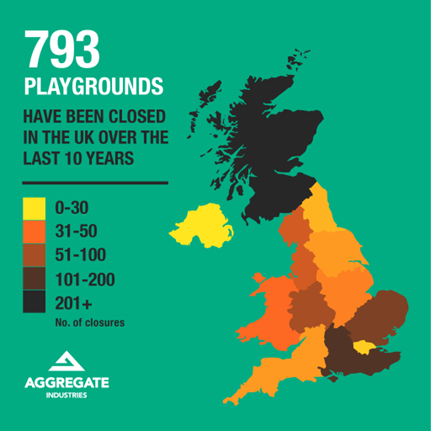
This new data shows a total of 793 playgrounds have been closed in the UK over the last ten years. It also revealed that there have been 28,734 reports of vandalism and 2,786 injuries in play parks across the UK over the last five years.

The latest data comes after a separate series of freedom of information requests revealed local authorities shut 214 playgrounds in financial years 2014-16, blaming ‘unprecedented budget constraints’.

Reflecting on the recent insights, Kirstin McCarthy, Director of Sustainability of Aggregate Industries, said: “We know that playgrounds and access to them are an essential provision for young families – not only for physical wellbeing but also mental and emotional wellbeing too.

“We understand budgets are tight and funding to local governments is squeezed but naturally to see the closure of so many playgrounds is still surprising.

“Supporting the development of local communities is one of the key goals for Aggregate Industries and our sites actively contribute to the social and economic well-being of surrounding communities.

“We have worked in partnership with our local stakeholders providing specialist surfacing, concrete and aggregates for local playgrounds, skateparks and schools and see the huge positive difference it can make.

“We want to do what we can to ensure access to good facilities isn’t a postcode lottery. Every child deserves to play.”

The key statistics: The regions that lost the most playparks

Aggregate Industries’ research showed that Scotland has closed the most play parks over the last decade. A total of 312 parks were closed north of the border, while the South East and East of England also closed 103 and 65 parks respectively.

A full breakdown of the regions can be found below
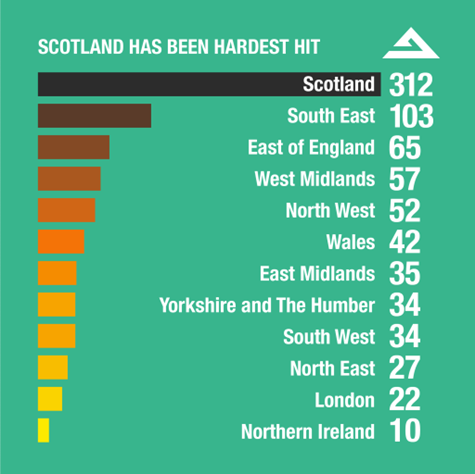
RankRegionNumber of play parks closed in the last ten years*
1Scotland312
2South East103
3East of England65
4West Midlands57
5North West52
6Wales42
7East Midlands35
8Yorkshire and The Humber34
9South West34
10North East27
11London22
12Northern Ireland10

The key statistics: the most reports of vandalism

As mentioned earlier in this article, a key area factor for families wanting to take their children to a playpark is that it is a safe environment.

However, with data showing there have been 28,734 reports of vandalism in UK play parks over the last five years,there is a wider issue beyond just parks disappearing across local communities.

In April 2022, Syston Town Council reported that a wave of ‘petty and mindless’ vandalism was threatening the future of its playparks, citing a series of destructive acts recently, ranging from play areas’ surfaces being damaged as well as bins and fences being smashed.

They are also one of many councils that said it was struggling with finding drugs paraphernalia and broken glass in public places while noting there was a ‘noticeable’ rise in anti-social-behaviour during the school holidays.

Aggregate Industries’ freedom of information requests shows that Bedford Borough Council received more vandalism reports than any other local authority by a distance in the last five years. Meanwhile, Dudley Metropolitan Borough and Portsmouth City Council each received more than 1,000 complaints during that time.

The top 10 can be found below:

RankLocal authorityReports of vandalism in the last five years**
1Bedford Borough Council13,609
2Dudley Metropolitan Borough1,355
3Portsmouth City Council1,302
4Calderdale Metropolitan Borough Council802
5Halton Borough Council721
6Darlington Borough Council708
7Wolverhampton City Council649
8Crawley Borough Council589
9Gravesham Borough Council578
10Sunderland City Council553


The key statistics: the most reports of injuries

With vandalism being such an issue across the UK’s local playparks, it is no surprise that it has led to injuries.

London Borough of Hackney revealed that it had 529 reports of injuries on its playparks over the last five years. London Borough of Greenwich also featured in the top three local authorities to have dealt with the most injuries.

The top 10 are as follows:

RankAuthorityInjuries reported in play parks in last five years***
1London Borough of Hackney529
2Hull City Council448
3London Borough of Greenwich215
4Essex County Council62
5Bradford Metropolitan Council58
6Telford & Wrekin Council49
7North Tyneside Council38
8Cheshire East36
9Fermanagh & Omagh District Council34
10Lisburn & Castlereagh City Council32

Analysis

There are several factors to consider as to why so many playparks have been closed over the last decade.

Children’s playparks are closing down due to budget cuts, maintenance costs, and safety concerns. Many cities and towns are facing monetary constraints, and maintaining playgrounds has become an unaffordable expense. Additionally, playgrounds can be dangerous if they are not properly maintained, and the cost of keeping up with safety standards can be too high for some local governments.

Back in 2020, The Association of Play Industries (API) launched its #PlayMustStay campaign, which showed there had been a 44 per cent decrease in spending on public play areas since 2017 as local authorities across the UK were forced to make difficult decisions about where and how they best spend their budgets.

Recurring vandalism has also proven a significant issue in children’s playparks and not in one isolated location. A quick Google search highlights that vandalism, including damaging expensive equipment worth thousands of pounds, setting fires, and graffiti, is not only making playparks dangerous for families but is also resulting in huge repair bills for councils.

Psychologist on the importance of outdoor play

Reviewing the data, Dr Helen Dodd, a Professor of Child Psychology at The University of Exeter said: “Outdoor play provides opportunities in terms of exploring different emotions, feelings and movements with your body and your mind.

“It’s about playing with excitement, thrill and fear. Our research proposes that having those opportunities helps to prevent mental health problems in children, particularly anxiety and depression.”

“It’s problematic if children don’t have a place to go to play that’s safe. Playgrounds have a very important role, as they are the number one place for children to play when they’re not home.

“If we take them away, we remove opportunities, and as a result what we get are children who stay indoors more, who are less physically active, who get less vitamin D, and are missing out on those opportunities to learn about uncertainty, risk, challenge and things they might experiment with at playgrounds.

“They’re also missing out on opportunities to make new friends, socialise and feel connected with other people in their area.”

What parents had to say

Steve, a 33-year-old dad from Sheffield, explained how he feels trepidation every time he visits his local playground: “My twin boys love being outside, so our local park is usually guaranteed a visit at least once a week, but it’s always a coin-toss as to what state we’ll find it in.

“Broken glass, dog mess and litter are always issues, but sometimes the play equipment itself is damaged or broken completely – and there’s nothing worse than trying to explain to two three-year-olds why they can’t play on a busted swing.”

Sara is from Ilkley and used to often visit her local playground with her 6-year-old daughter. Lately, she’s found it difficult to access the right kind of facilities for her daughter: “Our local playground only really has equipment suitable for younger children and, now that my daughter is almost 7, there is hardly anything she can play with.

“Not to mention that the equipment that is there is falling apart and hasn’t been replaced in years. If we want to visit a playground suitable for her age we have to drive, which defeats the point.

“Playgrounds are a real godsend for parents and outdoor play is so important for children’s development and mental well-being. At a time when parents and children are struggling with their mental health, not to mention the rising cost of living, playgrounds should be considered a priority by councils as they tick so many boxes.”

Similarly, Stuart from Nottingham shared his experience with taking his 3-year-old daughter to the parks closest to him: “There are a few parks within walking distance from where we live. However, someone set fire to one of them recently, and there’s also constant graffiti.

“It means you have to be careful what your kids play on – my daughter’s clothes get covered in soot if we’re not always careful, and she’s often exposed to graphic graffiti. One of the other parks is very poorly maintained – there are no swings or slides anymore, and it’s only really good for taking her to run around or push her scooter.

“During the pandemic, play parks were the only place we could go with her outside and they were seemingly never maintained during that period since they were constantly covered in litter. “It feels like, with massive budget cuts for local authorities over the last decade, play parks just aren’t prioritised as much as they should be. Play is vitally important for children to learn about themselves, the world around them and their place in it.”

Related Posts

ELAN ACQUIRES LAND FOR NEW HOMES IN SHUTTINGTON

WORK to create 24 high-quality new homes in North Warwickshire is due to start in spring/ summer following the sale of a three-acre parcel of land by a leading property consultancy. Fisher German recently completed the sale of the site off Main Road in Shuttington to...

Subscribe